
大秦帝国
Twin AI satellites fast-track China's global space partnerships_我的网站

A | The cell phones, tablets, and laptops left behind by veterans who died by suicide may offer insight that could help prevent future military suicides, according to a nonprofit dedicated to analyzing the data from the devices.Stop Soldier Suicide collects the technology as part of its initiative, "The Black Box Project," which is named after the black boxes found on planes that help determine the cause of aviation incidents."If we could gather novel data from those that have died by suicide, we might be able to recreate the last year of life," Stop Soldier Suicide CEO Chris Ford told ABC News.Veterans are 57% more at risk for suicide than non-military adults and around 6,000 veterans die by suicide each year, according to the Department of Veterans Affairs."I think we can prevent needless suffering and a ton of loss of life," Ford said.That kind of loss is something David McDaniel, whose son Connor died by suicide at the age of 26, knows all too well.Connor McDaniel joined the Army after high school, and, according to David, he appeared upbeat during his deployment to Afghanistan, where he was assigned to protect local villages from the Taliban."Some of his Army buddies told me that he was making them laugh while they were being shelled in Afghanistan," David McDaniel told ABC News.But it wasn't long after Connor came home that David McDaniel says he sensed a shift in his son's behavior to include "more anger, a lot of frustration, a lot of gloominess."On Sept. 1, 2021, David says his son entered a wooded area with a firearm."I start screaming his name as I'm walking up the field. And just then the police, the sheriff's department shows up and they tell me to come back down," McDaniel said.He followed their direction, but on the car ride home, an officer called him and said Connor was dead after he fired upon sheriff's deputies and the deputies returned fire and killed him.Connor's death was determined to be a suicide. The district attorney's office concluded that the officers' actions were justified.While grappling with his son's death, David McDaniel was immediately drawn to the Black Box Project, which uses forensic software to unlock and comb through service members' devices provided by their loved ones to review their activity in the weeks leading up to their suicides.McDaniel works in the tech field and says if the project can find repeated patterns in online searches, they may be able to help others to prevent suicides.For instance, McDaniel says his son searched for SGLI, Servicemembers' Group Life Insurance, before his death. If a veteran were to make a similar search and look up "suicide" in the future, for example, McDaniel suggests it could trigger an ad for Stop Soldier Suicide to pop up and provide resources in the search results.Ford says the nonprofit uses machine learning, a subfield of artificial intelligence, to analyze texts and notes in order to determine sentiment or emotional tone, such as anger or desperation. He says they can also track phone usage of the deceased veterans to monitor their past sleep cycles and trace their past geo-locations."Machines can go through computations a lot faster than humans, and they can find signals that we often miss," Ford said.Since launching the Black Box Project in April 2020, Stop Soldier Suicide has received over 100 devices, Ford said. So far, he says they're seeing three patterns before most of these suicides: more anger, different sleep patterns, and social isolation.Ford's team includes Ph.D.s in clinical psychology and suicide researchers. A scientific advisory committee helps steer where and what to look for on the devices.The findings are still preliminary, according to the nonprofit, but one goal is to help the organization decide where, when, and how to target their own mental health resources, like adding more hotline staff at certain hours and ensuring calls are picked up overnight.When asked about privacy concerns of collecting data, Ford said it's something they think about daily."We don't resell the data. We don't push it out to others. We use it for our own research purposes so that we can best understand risk and then give those devices back to those families intact," Ford said.Current privacy laws do not carry on past death, meaning the next of kin typically gains new authority.Petra Oxford-Jackson, whose veteran husband Anthony died by suicide, says she gave his phone to the organization with the possibility it could save even one life."I truly believe he would have been okay with it, and it's a hard thing for a survivor to give up something so personal as his cell phone," Oxford-Jackson told ABC News.The Black Box Project received $3 million in funding from the Department of Veterans Affairs earlier this year.If you are struggling with thoughts of suicide or worried about a friend or loved one, call or text the Suicide & Crisis Lifeline at 988 for free, confidential emotional support 24 hours a day, seven days a week.。
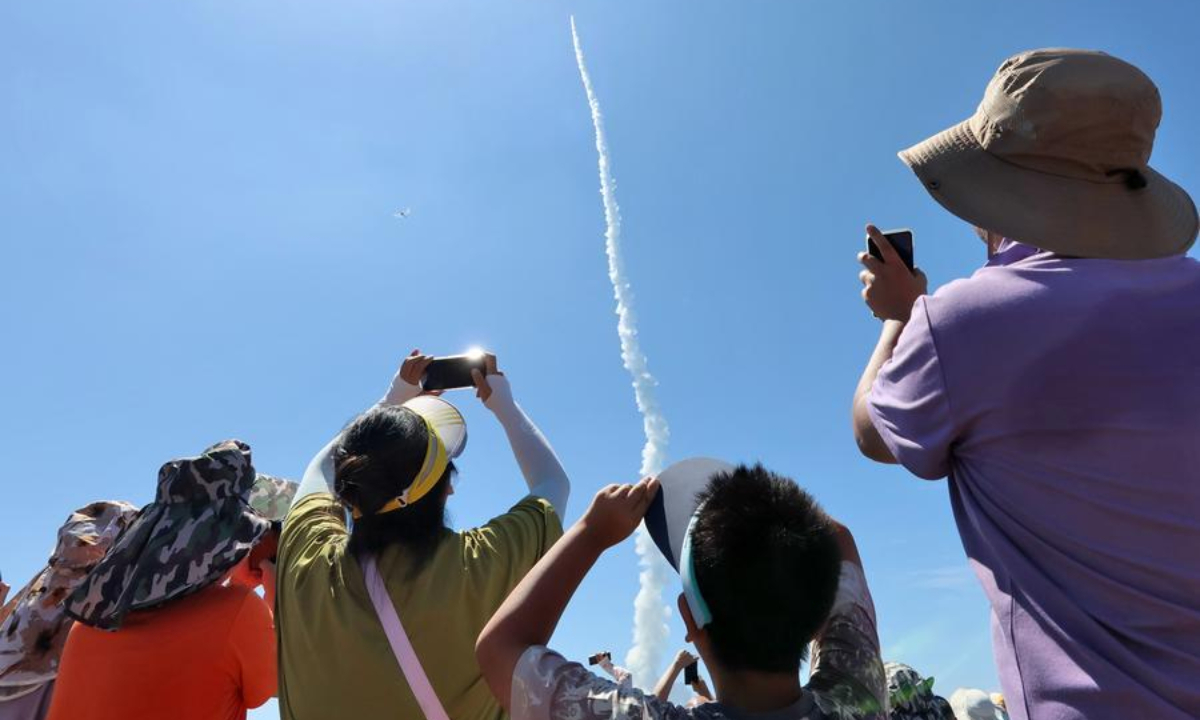
A burst of flame lit the morning sky over waters off Haiyang in east China's Shandong Province on Wednesday as a Smart Dragon-3 (SD-3) carrier rocket lifted off, drawing cheers from viewing sites along the coast.
Among the spectators were international students studying aerospace subjects in China. Aithana Perez, a Venezuelan aeronautical engineer studying space project management at Hangzhou Innovation Institute of Beihang University, said she and her classmates were excited because their studies involved spacecraft launch, design and operation.
For Marwane Oufrid, a 23-year-old Moroccan student in the same institute specializing in microsatellite technology, it was the first time he had watched a rocket launch in person.
The rocket blasted off at 10:38 a.m. (Beijing Time), delivering the Oriental Smart Eye hyperspectral satellites 01 and 02 into planned orbit.
In their respective cooperation projects with Indonesia and Uzbekistan, Satellite 01 is also known as Lampung-1 and Satellite 02 as Samarkand-2028.
Once in orbit, the satellites turned their attention back toward Earth. Lampung-1 is expected to monitor crop growth and disaster risks in Indonesia, while Samarkand-2028 is designed to support cotton cultivation and other land-monitoring applications in Uzbekistan.
Ordinary optical cameras mainly record the shape and color of objects. Hyperspectral imagers record a detailed spectrum for each image pixel, creating "spectral fingerprints" that can help determine the condition and composition of vegetation, water, soil and minerals.
These spectral "eyes" are paired with onboard AI computing modules capable of delivering up to 400 trillion operations per second. Instead of sending every raw image to the ground, the satellites can identify features, detect anomalies and extract useful information in orbit, potentially shortening delivery time from days to minutes.
Song Bingchen, co-founder of the Star.ai Spatio-temporal Intelligence Technology Co., Ltd., whose subsidiary STAR.VISION developed the satellites, compared the system to moving an AI inference platform from the ground into space.
"It changes the traditional model from transmitting images to transmitting results," Song said.
"Our satellite constellations are open to the world," Song noted, adding that the company welcomes international partners to jointly invest in, build and use the satellite networks.
In Indonesia, Lampung-1's planned applications are centered in Lampung Province on the island of Sumatra. Agriculture, forestry and fisheries accounted for 28.38 percent of the provincial economy in the third quarter of 2025. The satellite will also support marine resource management, environmental monitoring and disaster response.
Rahmat Mirzani Djausal, governor of Indonesia's Lampung Province, described the successful launch as a "historic moment" for the province.
"Cooperation with China on this satellite project is of historic and strategic significance," he said. "It marks the beginning of Lampung's transformation into a technologically advanced province."
The governor commended China's openness in sharing space technology and its commitment to long-term cooperation.
"China understands that any problems we face on one side of the world will ultimately impact the other side. Therefore, it is essential to empower regions that are left behind to make the world ultimately a better place," he said.
This cooperation also extends to people. Lampung is preparing to send over 100 young professionals to China for training in remote sensing and satellite communications, with the goal of building local capacity in satellite operation, data processing and spatial analysis.
In Uzbekistan, the applications center on cotton, grain and vegetation monitoring. Samarkand-2028 is designed to follow cotton cultivation from sowing to harvesting, while Uzbekcosmos has said hyperspectral data will also be used to produce national cotton and wheat maps.
Mukhiddin Ibragimov, deputy director of the Uzbekcosmos Agency, described the project as one of the largest international space projects in Uzbekistan's history and a milestone in its national space program.
He called the launch "a great occasion," saying it was the first time Uzbekistan had participated in an international space mission of such scale.
Ibragimov said Uzbekistan sent a technical team to China early in the project and formed a working group with Chinese specialists to develop an AI model for onboard data analysis. This model focuses on crop classification, including cotton verification, grain identification and vegetation monitoring.
The resulting data will support agriculture, water resource management, environmental protection and emergency monitoring, among other applications, he revealed.
Ibragimov said no single country can handle all space-related tasks alone.
"We believe that partnership brings value. We see that China is doing the same thing," he said, adding that Uzbekistan is exploring further satellite cooperation with China.
The projects offer a commercial example of the approach set out in China's 2021 space white paper, which called for international cooperation based on equality, mutual benefit, peaceful utilization and inclusive development.
Back in Haiyang, Oufrid said projects of this kind could give more countries an opportunity to participate in the space sector. He expressed the hope to see such cooperation happen more often and "maybe someday with Morocco as well."
。
Current article:http://9w06no2.linxiuhuaishuangniuzhenrua.bond/list_ta4jz/957xgy.html
Published on:07:05:23


大秦帝国TXT下载声明:
1 我的网站免费提供的大秦帝国,均由网友上传,供下载测试之用,不作商业用途,下载后请二十四小时后删除!
2 我们根据txt小说全文所整理出大秦帝国txt电子书全集免费下载,由程序自动生成大秦帝国txt下载文件。
3 书友所发表的txt小说大秦帝国的相关评论,并不代表本站赞同大秦帝国txt下载或者支持大秦帝国的读者观点。
4 如果发现小说《大秦帝国txt全集》无法下载未及时更新请联系我们。如果您喜欢大秦帝国txt电子书,请支持作者到书店购买正版图书。感谢您的合作与支持。
5 好看的小说大秦帝国是作者"百年不渡"的最新力作,大秦帝国电子书由网友发布;小说大秦帝国版权属于作者所有,如果侵犯您的利益,请通知我们。